Lake Hartwell Border Waters: Georgia or South Carolina Rules?
Lake Hartwell straddles Georgia and South Carolina, so a day on the water can involve more than one set of boating rules. The practical answer is to know which state’s waters you are in, carry accepted proof of education and registration, and prepare for the stricter applicable safety requirement when you are unsure.
Which State’s Rules Apply on Lake Hartwell?
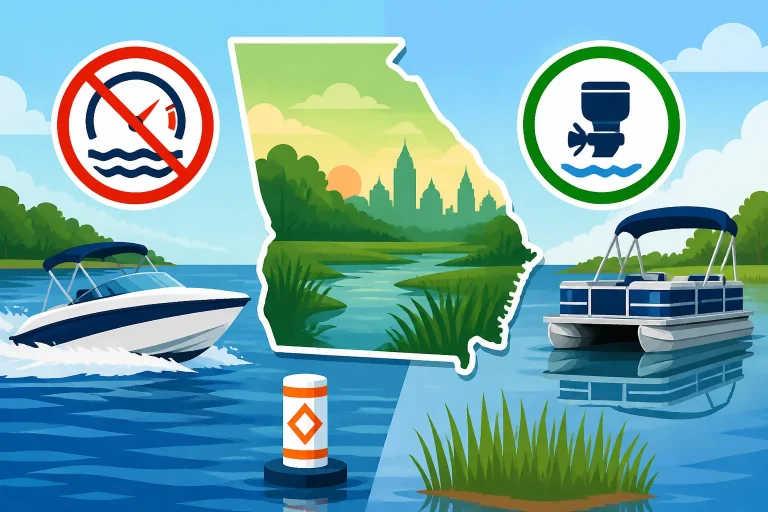
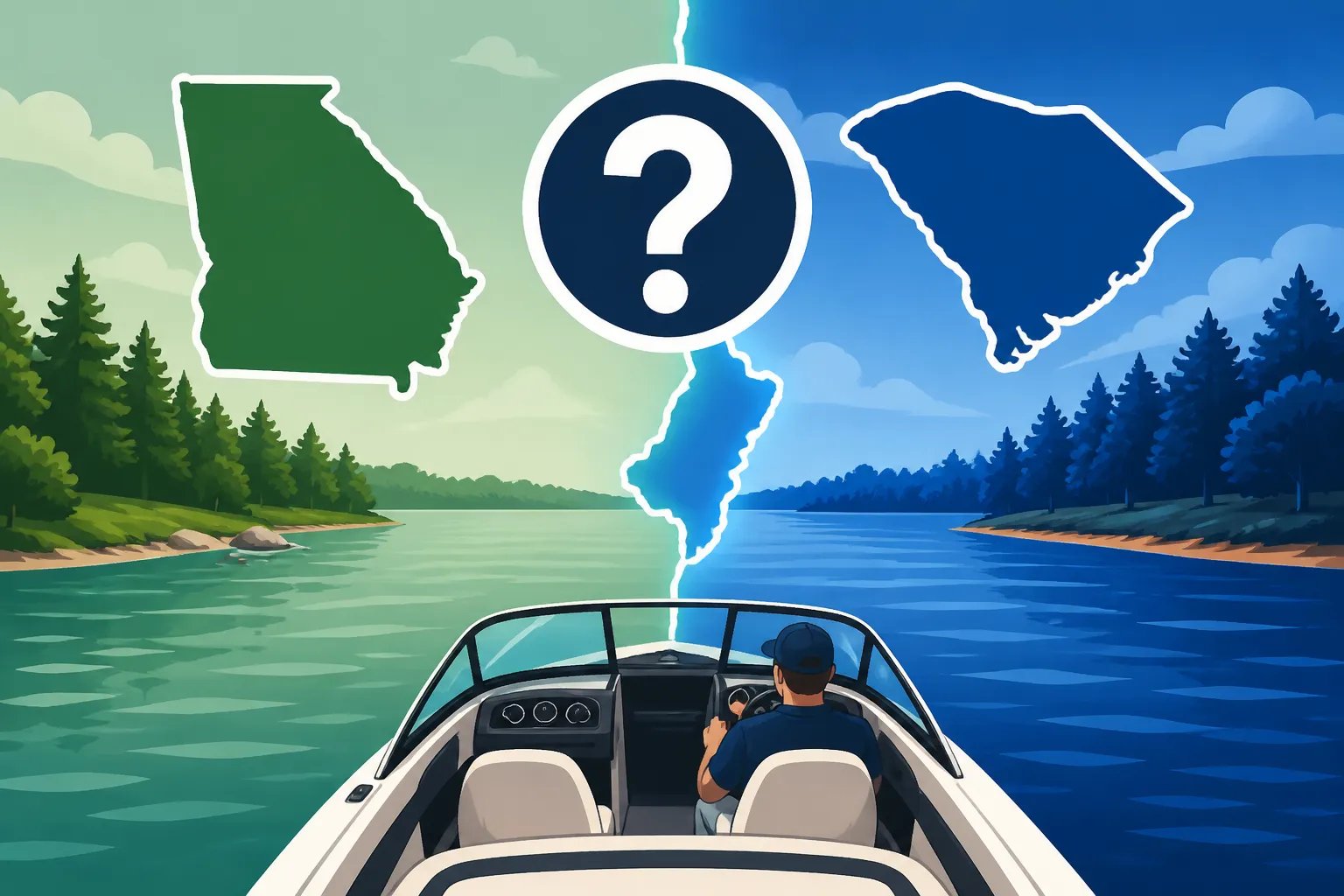
Lake Hartwell is a border reservoir, but its shoreline does not mark the state line in a way you can reliably follow from the boat. The state boundary runs through the lake, and where you are operating can matter. Georgia law generally applies on the Georgia side and South Carolina law on the South Carolina side. Federal rules and project requirements may apply across the reservoir as well.
That does not mean every boating question has a simple answer based only on your position. The particular rule, the circumstances and the authority enforcing it can all matter. A boat may leave a Georgia ramp, cross into South Carolina waters during the outing and return to Georgia without any obvious change in scenery. A border crossing is not a reason to assume the rules have stopped applying.
The U.S. Army Corps of Engineers manages the Hartwell project. Its rules and restrictions can affect how boaters use the reservoir, while state boating laws cover matters such as operator requirements, safety equipment and conduct on the water. State and federal authorities may have different roles, and more than one authority may be relevant to an incident.
| Question | Practical starting point |
|---|---|
| Which state’s boating law applies? | Identify whether you are operating on the Georgia or South Carolina side; confirm how the particular rule applies if the location or incident is near the boundary. |
| Who manages the reservoir? | The U.S. Army Corps of Engineers manages the Hartwell project; check its current notices and restrictions as well as state rules. |
| Is a home-state boat registration enough for a visit? | A valid registration from your home state is generally the starting point for a visiting boat, but residency, duration of use and vessel circumstances can affect requirements. |
| Does one education card work in both states? | Do not assume. Check whether the issuing course or certificate is accepted by both Georgia and South Carolina. |
| Which safety standard should you follow? | Meet the requirements that apply where you are operating. If you cannot tell which rule controls, meeting the stricter relevant requirement is a sensible precaution. |
The table is a planning aid, not a substitute for checking the rule that applies to your boat and situation. For a broader explanation of how state lines affect vessel paperwork, see Georgia Border Waters and Boat Registration: Where Two States Meet. For a sense of the lake from the Georgia side, Lake Hartwell From the Georgia Side: What Lanier Boaters Find can help with trip planning.
Don’t rely on a visible line on the water
A map can help you understand the border, but it is not a substitute for current official information. Before leaving, look at a current chart or other reliable navigation map, note your intended route and avoid treating a cove, point or shoreline as proof of which state you are in. GPS may help with orientation, but it can be imprecise near a boundary and should not be treated as a legal determination.
The practical aim is to avoid being caught off guard. If you may cross into the other state, plan as though you could be subject to its applicable requirements during the outing. That is especially useful when checking education documentation, equipment and operating rules that may differ.
Education and Registration When You Cross the Border
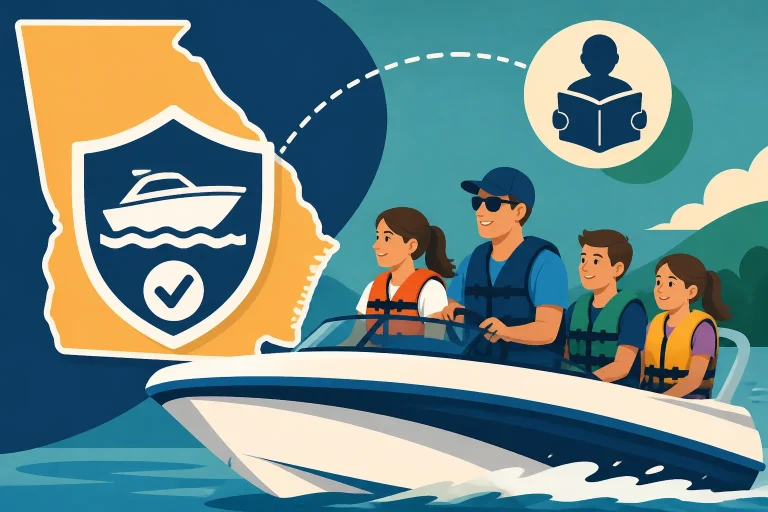
Boater education requirements are based on the laws of the state whose rules apply to the operator and activity. Georgia and South Carolina do not necessarily use the same birth-date threshold or the same details for who must complete a course. A boater who satisfies one state’s rule should not assume that the same course record, age or exemption automatically settles the question in the other state.
Georgia has a boater education requirement for certain operators born on or after January 1, 1998, subject to the law’s details and exceptions. South Carolina has its own requirements. Check the current rules for both states if your Hartwell trip may take you across the line, particularly if a young operator will be driving. Georgia Boater Education Requirements, Start to Finish explains the Georgia side; the state’s official boating authority can confirm the current South Carolina requirements.
A course certificate and an indicator on a driver’s license are not necessarily interchangeable in every circumstance. Carry the original or otherwise accepted proof for the course you completed, and confirm what each state accepts before launching. If you completed a course through a commercial provider such as BoaterExam, check that the specific course and certificate meet the requirements of both states you plan to visit. The provider name alone does not establish that a course is accepted everywhere.
For visitors, the key is not simply whether you once took a course. Be prepared to show acceptable evidence if asked. If you are unsure whether an out-of-state card is recognized in Georgia, see Does Georgia Accept an Out-of-State Boater Education Card?. Visitors can also review Visiting Georgia With an Out-of-State Boater Card: What DNR Expects before setting out.
Registration usually follows the vessel, but check your situation
A boat registered in one state is not automatically required to be registered again just because it crosses a state line for a day trip. For a visiting vessel, valid home-state registration is generally the starting point. That does not resolve every case: residency, how long the boat is kept or used in a state, and the type or status of the vessel can affect what paperwork is required.
Keep the registration card aboard and make sure the vessel’s identification numbers and decals are displayed as required by its registration state. Do not rely on a phone photo as a replacement for a document that the law requires you to carry. If you have recently moved, bought a boat, or plan to keep it on one side of the lake, check whether you need to register it in a new state rather than treating the trip as a temporary visit. Georgia Boat Registration: A Plain Walkthrough for First-Time Owners covers the Georgia process, while Which Boats Need DNR Registration on Georgia Waters? can help you decide whether your vessel needs Georgia registration.
A rented or borrowed boat needs a little extra attention. Ask the owner or rental operator which state the vessel is registered in and where the required documents are kept. The operator may have education obligations of their own, even when someone else owns the boat. If a teenager is operating, confirm the rules for that operator, the boat and the state waters involved rather than relying on the owner’s paperwork.
Safety Equipment and Operating Rules Across Two States
A boater should not treat Lake Hartwell as a place where one state’s safety rules can be used as a shortcut for the other’s. Requirements may vary by state, vessel type, operator or passenger age, and activity. Check the applicable rules for your actual boat and planned use. Where it is easy to do so, carrying equipment that meets the more demanding relevant standard can reduce uncertainty, but it does not replace checking the law.
Life jackets and other required equipment
Start with a complete safety-gear check before the boat leaves the ramp. Confirm that required life jackets are aboard, in usable condition, appropriate for the people who will wear them and accessible when needed. Requirements can depend on factors such as passenger age, whether the boat is moving and the type of vessel. A jacket stored under a pile of gear may be harder to use in an emergency, even if it is technically aboard.
Check the rest of the required equipment for your vessel too. Depending on the boat and circumstances, the list may include a sound-producing device, a fire extinguisher, navigation lights or a throwable flotation device. Requirements are not identical for every boat, and a checklist for a different vessel may not fit yours. For the Georgia-side details, see Georgia Life Jacket Laws Explained for Adults and Children and Life Jackets and Safety Gear Georgia Boaters Must Carry.
A retailer such as West Marine may be one place to find marine safety gear, but buying an item does not by itself establish that it meets the legal standard for your boat or passenger. Check the label, condition, size and applicable requirements before relying on it. Replace damaged or unsuitable equipment, and make sure everyone aboard knows where it is.
Alcohol and responsible operation
Georgia and South Carolina have their own laws concerning impaired operation of a vessel. Do not assume that the threshold, enforcement procedure or consequences are identical on both sides of the lake. The safest practical rule is simple: the person at the controls should not drink or use drugs in a way that could impair safe operation. Passengers should avoid distracting the operator or interfering with navigation.
A crowded reservoir leaves little room for delayed reactions. Keep a proper lookout, operate at a speed that suits visibility and traffic, and give other boats, swimmers and shorelines appropriate room. Use extra care in coves, near docks and around busy launch areas. If you are towing someone, confirm that the equipment, observer and operating conditions meet the applicable rules before starting. For the Georgia law, see Georgia Boating Under the Influence Law, Start to Finish.
Navigation and local restrictions
The ordinary rules of safe navigation still matter when a state boundary is involved. Give way as required, avoid sudden changes in direction and do not assume another operator understands your intentions. If you need a refresher on crossing, overtaking and narrow channels, Right-of-Way on Georgia Waters: Crossing, Overtaking, Channels offers a useful Georgia-focused overview.
Check for current lake restrictions and notices before leaving. Corps project rules, temporary closures, construction, water conditions and local controls can affect where and how you may operate. A familiar route may not be suitable on every outing, especially if weather, visibility or traffic has changed. Do not assume a restriction ends at the state line; verify the boundary and the terms of the notice.
A Practical Plan for a Georgia–South Carolina Hartwell Trip
A little preparation is usually easier than sorting out a paperwork or equipment question at the ramp. Before launching, identify your likely route, the state waters you may enter and the rules that could apply to your operator and vessel. If your plans change on the water, slow down, reassess the route and avoid crossing into an area you do not understand simply because it looks convenient.
Use this checklist before the trip:
- Confirm the boat’s status. Check that its registration is current, the registration card is aboard and required numbers and decals are properly displayed. If the boat is borrowed or rented, ask the owner where the documents are kept.
- Check operator education. Confirm whether the operator must meet an education requirement in either state and carry proof accepted by the relevant authority. Pay particular attention when a young person will operate.
- Inspect safety gear. Make sure required equipment suits the vessel and people aboard, is in serviceable condition and can be reached quickly.
- Review current restrictions. Check the Corps and relevant state boating authorities for notices, closures and rules that affect your route or planned activity.
- Orient yourself to the border. Use a current map or chart to understand where the state line lies. Do not assume that a particular shoreline or cove is on the side you expect.
- Plan for changing conditions. Leave room in the schedule to turn back or choose a different route if weather, visibility, traffic or water conditions make a crossing unwise.
- Brief everyone aboard. Show passengers where the life jackets and other safety gear are, explain how to avoid distracting the operator and make sure they know what to do if the boat stops or someone falls overboard.
If an officer asks questions
A stop can be routine. Stay calm, follow lawful directions and avoid reaching into compartments without explaining what you are doing. Keep registration and education documents in a place where you can retrieve them safely. If you are unsure which agency or state rule is involved, you can ask politely what is being checked.
An officer’s presence does not mean a particular state’s law applies everywhere on the reservoir, and a state line does not mean enforcement ends there. The best response is to have the relevant paperwork and equipment ready, answer questions honestly and deal with any citation through the stated process. Georgia DNR Game Wardens on the Water: What They Check offers more context on the Georgia side.
If an incident occurs, focus first on immediate safety and getting help. Do not assume that the reporting process is identical in the two states. The location, type of incident and applicable requirements can affect which authority must be notified and how. Keep a record of the location, people involved and actions taken, and follow directions from responding officers.
Frequently Asked Questions
Can I take a Georgia-registered boat into South Carolina waters on Lake Hartwell?
A valid home-state registration is generally the starting point for a visiting boat, but your residency, how long the vessel is kept in a state and the boat’s circumstances may affect what is required. Keep the registration card aboard and confirm the rules if you are moving the boat or keeping it on the South Carolina side.
Does a Georgia boater education card automatically work in South Carolina?
Do not assume it does. Check whether the specific course or certificate is accepted under South Carolina’s current requirements, especially if the operator falls within a required age group. Carry accepted proof rather than relying on memory or a course-provider name.
Do Georgia safety rules apply across all of Lake Hartwell?
No single state’s rules should be assumed to cover the entire reservoir. The state whose waters you are operating in can matter, and federal or Corps requirements may also apply. Check the rule for your location and activity, and verify current restrictions before launching.
Who manages Lake Hartwell?
The U.S. Army Corps of Engineers manages the Hartwell project. State boating authorities also have roles in enforcing applicable state laws. Check both the relevant state information and current Corps notices when planning a trip.
Disclaimer
This article is for general informational purposes only and does not constitute professional advice. Laws, prices and regulations vary by location and change over time. Consult a qualified professional for guidance on your specific situation.