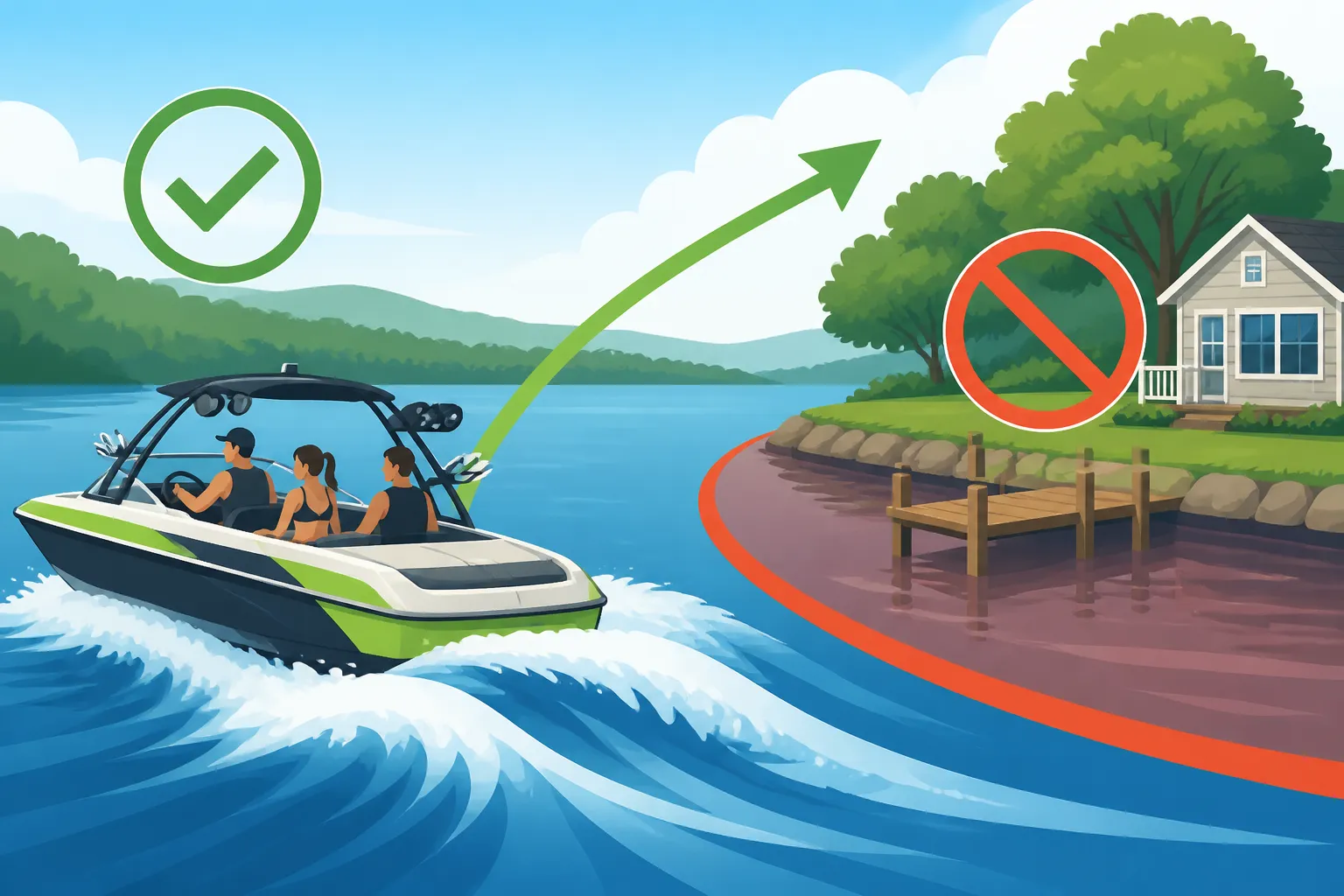
Wake Boat Rules in Georgia: Staying Clear of Docks and Shorelines
A wake boat can be legal to operate and still create a problem if its wake reaches a dock, shoreline, swimmer or another vessel. Georgia’s rules are especially important when wakesurfing, but safe operation also depends on where you ride, how you control the boat and what local restrictions apply. Here’s how to plan a wake-boat outing with the right distances and fewer surprises.
The Georgia rules wake-boat operators need to know
Georgia law sets a minimum distance for wakesurfing: keep at least 200 feet from shorelines, docks and similar structures. Treat that distance as a legal floor, not as a guarantee that your wake will be harmless. A large wake can travel well beyond the boat’s immediate path, and a location that barely meets the minimum may still be too close for the conditions.
The rules apply to the activity, not just the boat’s name or design. A wake boat may be used for cruising, towing a skier or wakeboarder, or wakesurfing. Requirements can differ depending on what the boat is doing. Before switching from cruising to towing or surfing, check that your location and setup meet the rules for the new activity.
Other requirements can affect the outing, too. Towed water sports have rules involving safe operation, watching the person in the water, equipment and permitted operating hours. The operator also has a general duty to maintain a proper lookout and operate at a safe speed. For a broader overview, see Towed Water Sports in Georgia: Skiing, Tubing and Observers and Georgia Powerboat Operation Rules: Speed, Lookout and Care.
A quick way to keep the main ideas straight:
| Situation | Practical rule to apply |
|---|---|
| Wakesurfing near shore or structures | Keep at least 200 feet from shorelines, docks and similar structures; give more room when the wake or conditions call for it. |
| Towing a person | Follow Georgia’s towing requirements, including rules for observation, equipment, safe operation and legal hours. |
| Cruising near docks or anchored boats | Reduce speed and avoid creating a hazardous or damaging wake. Follow posted restrictions. |
| Boating in a cove or marina | Expect narrow space, nearby boats and possible no-wake or idle-speed requirements. |
| Operating on a managed lake | Check the lake manager’s rules as well as statewide law. |
The distance requirement does not replace the general responsibility to operate safely. If a dock is well outside the minimum but a large wake is still rolling into it, you may need to move farther away or change your speed and direction. Conversely, a calm-looking stretch of water is not permission to ignore the minimum distance.
Rules can also depend on the lake. Georgia waters may be managed by different authorities, and local restrictions or posted signs can add limits. A rule that works on one reservoir may not cover a cove, marina entrance or special-use area on another. Check the current rules for the exact waterway before launching.
For a focused look at the distance question, see Wakesurfing in Georgia: How Far From Shore Do You Need to Be?. For other tow-sport requirements, Wakeboarding and Wakesurfing Law in Georgia: What Changed can help you separate the rules for different activities.
What the 200-foot setback means in practice
A distance rule is straightforward on paper and less straightforward on water. The operator has to judge where the boat is in relation to shore, docks and other structures, while also accounting for the path of the boat and the room needed to turn or stop safely.
Use the 200-foot minimum as a buffer to protect, not a target to skim. A boat that is exactly the minimum distance away leaves little room for error if it drifts toward shore, turns sharply or is pushed off course. Start farther out whenever the waterway allows. If you cannot confidently maintain the required separation, choose another place to ride.
Measure the whole riding area, not one point
A wake-surfing pass includes more than the moment when the rider is behind the boat. Consider the entire route: where the boat will accelerate, where it will hold its course, where it will turn and where it will slow down. A route that begins at a safe distance can become unsafe if the turn brings the boat close to a dock or shoreline.
Before the first pass, identify nearby features:
- Shorelines, points and islands
- Docks, piers and boathouses
- Moored or anchored vessels
- Swimmers and other people in the water
- Bridges, marinas and narrow passages
- Marked channels, buoys and restricted areas
- Other boats running tow sports nearby
Plan a route with room to complete a full pass and turn without cutting toward those features. If the usable open water is too small for that route, do not wakesurf there.
Give room to people and other boats
The 200-foot shoreline setback does not mean the water immediately beyond that line is available for every maneuver. Other vessels may be crossing, fishing, anchored or towing someone. Paddlers can be difficult to see, particularly in glare or heavy boat traffic. A safe wake-surfing area needs space around the boat and rider, not simply a clear line to the bank.
Keep enough separation that another operator can see what you are doing and avoid your path. Do not assume that another boat will hold course or understand your next turn. Slow down or wait if a vessel, paddler or swimmer enters the route. The right-of-way rules can help explain who should yield, but avoiding a collision remains more important than insisting that someone else move. See Right-of-Way on Georgia Waters: Crossing, Overtaking, Channels for a closer look at passing situations.
Respect signs and local limits
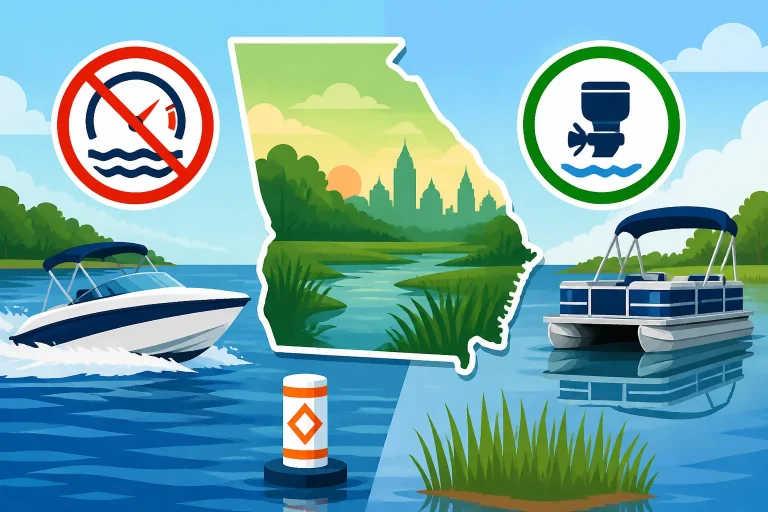
Posted signs may identify no-wake zones, restricted areas, speed limits or other local requirements. Follow them even if the area appears wide enough for a wake-sport pass. The term “no wake” is not an invitation to create a smaller wake; it means the boat must be operated so that it does not produce a wake under the applicable rule.
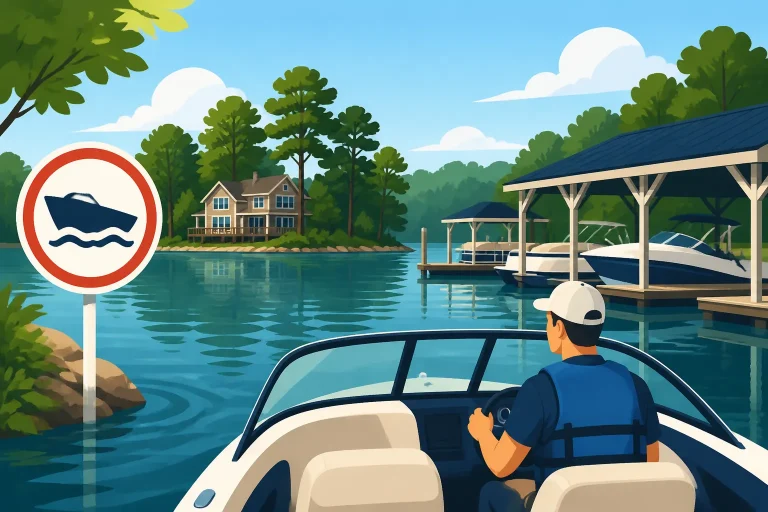
Marinas, ramps, narrow coves and waters near docks are common places to slow down. A location can also be unsuitable for wakesurfing even when there is no sign specifically naming the activity. A narrow channel, crowded cove or busy swimming area may not provide enough safe operating space. For a practical explanation of local slow-speed expectations, see No-Wake and Idle Speed Zones in Georgia: A Boater’s Orientation.
Why wake size and direction matter
A wake does not stop at the boat’s path. It spreads and can reach shore, docks and other vessels after the boat has moved on. Wake size and effect depend on more than the boat’s speed: hull design, boat loading, ballast, trim, water depth, shoreline shape and the boat’s direction all matter.
That is why “I was going slowly” is not a complete safety check. Wake boats are designed to produce a substantial wave for riding. Their setup can magnify the wake, and a slow speed suitable for surfing may still send a strong wave toward nearby property. The required setback helps create room, but it does not make every pass safe.
Read the water before choosing a line
Look at the shoreline and the water surface before you begin. A steep bank, retaining wall or dock can reflect waves back into the water. In a narrow cove, wakes may bounce from one side to the other, leaving the area unsettled long after the boat has passed. A sheltered pocket can look calm while still being too confined for wake sports.
Notice whether other boats are already creating waves. Crossing wakes can make the ride uncomfortable or unpredictable for the person being towed. They can also complicate steering and reduce the operator’s ability to keep a clean lookout. If traffic is building, wait for a gap or move to a more open area.
Consider the people and property beyond the rider
A wake can rock a small boat, unsettle a fishing vessel or make it harder for a paddler to stay on course. It may also wash over a low dock, move a moored boat against its lines or disrupt someone swimming near shore. Operators should consider those effects before choosing a route, not only after someone complains.
That does not mean every wave reaching a distant shore is automatically a violation. It does mean wake impact is part of responsible operation. If a route repeatedly sends large waves into a dock, moored vessel or occupied swimming area, change the route or stop the activity. Extra distance and a different direction are often more effective than arguing over whether the minimum was technically met.
Do not assume a wake disappears in deeper water
Depth can affect how a wake behaves, but it is not a reliable substitute for distance or observation. A deep stretch of water can still send waves toward a shoreline or dock. Likewise, a boat may make a wake that reaches a nearby structure even when the water looks smooth at the start of the run.
Use distance, open water and a clear route together. Watch what happens behind the boat after each pass. If the wake is reaching places you are trying to protect, move farther out or stop wakesurfing in that area.
Safe operation, towing and required gear
A safe wake-boat outing depends on more than picking a wide stretch of lake. The operator needs to control the vessel, monitor traffic and keep track of the person in the water. The person at the helm should be able to focus on driving rather than managing music, phones, passengers or equipment.
Before towing, confirm the boat has the equipment required for the activity and that the person being towed has suitable flotation. Georgia’s rules specify requirements for tow-sport operation, and the details can depend on the activity and equipment used. Review the current requirements in Life Jackets and Safety Gear Georgia Boaters Must Carry and Georgia Life Jacket Laws Explained for Adults and Children.
Assign clear jobs before leaving the dock
Agree on who is operating, who is watching the rider and how the rider will signal. The operator should know the intended route, the observer should keep attention on the rider, and passengers should know not to distract either person while the boat is moving.
Do not assume that a rear-view mirror automatically replaces every observer requirement. Georgia’s towing rules may specify when an observer is required and whether an approved mirror can be used in its place. Check the current rule for your activity and setup. A mirror is also not a substitute for a safe route or active attention to the rider.
Review simple signals before the first pass. The rider should know how to indicate that they are ready, want to speed up or slow down, or need the boat to stop. Keep the rope and board clear of the propeller, and do not put the boat into gear until the rider and line are safely positioned.
Keep the operator sober and attentive
Alcohol and boating are a dangerous combination, especially when a person is being towed. The operator must be able to judge speed and distance, watch for crossing boats and react quickly if the rider falls. Passengers should not pressure the operator to continue if conditions or judgment are deteriorating.
Georgia prohibits boating under the influence. The law applies to operating a vessel, not just to driving a car, and impaired operation can put everyone aboard and people in the water at risk. For details, see Georgia Boating Under the Influence Law, Start to Finish. Designate a sober operator before the outing, and do not treat a short ride or familiar lake as an exception.
Check the education requirement
Georgia requires certain operators to complete approved boater education, based on the operator’s date of birth and other applicable rules. The requirement may affect a resident, visitor, renter or person borrowing a boat differently depending on the circumstances. Confirm whether the operator must carry proof of education before the trip. Who Must Take Boater Education Under Georgia Law explains the main eligibility question.
A course can also help operators understand lookout, navigation and safe operating practices beyond the minimum legal rules. If you are comparing courses, choose one that meets Georgia’s current requirements. BoaterExam is one option to investigate, but confirm that the specific course and certificate satisfy the state’s requirements before enrolling.
Prepare the boat and rider
Inspect the towing setup before it leaves the dock. Check the rope, attachment point and board for damage, and make sure the rider’s flotation device fits and is suited to the activity. Stow loose items and keep the boarding area clear so the rider can enter and exit without stepping over a tangled line or crowded gear.
A pre-departure check should include:
- Life jackets for the people aboard and the person being towed
- Required safety equipment for the vessel
- A working engine shutoff and safe controls
- A tow line and attachment point in sound condition
- A clear view from the helm
- A way to communicate with the rider
- Enough fuel for the outing and a safe return
- Weather and traffic conditions that suit the group
West Marine may be useful for finding boating safety equipment, but a store listing is not proof that an item meets Georgia’s requirements. Match each item to the rules and the manufacturer’s instructions.
Choosing a suitable place and time
A suitable wake-surfing area should offer enough open water to maintain the required setback, make a full pass and turn without interfering with other users. The most scenic cove is not necessarily the safest place to ride. If it contains docks on both sides, swimmers near shore or boats anchored in the middle, choose a more open area.
Check the lake’s manager and posted rules
Georgia lakes and access areas can be managed by different agencies or owners. Some are federal reservoirs, some are associated with state parks and others have separate local management. Their rules, signs, access conditions and closures may differ. Identify who manages the water and check its current notices before you travel.
A general state rule does not override a stricter posted local restriction. Nor should you assume a rule from another lake applies to the one you are visiting. Use the ramp or marina staff as a source of local orientation when available, but rely on the posted rules and official information for requirements.
Choose a time with room to operate
Crowded water makes distance harder to maintain. Weekends, holiday periods and warm-weather afternoons can bring more boats, swimmers and paddlers into the same area. If the lake is busy, consider riding earlier or later when conditions allow, or select a less congested section of water. A quieter time does not remove the legal distance requirement, but it can make safe operation easier.
Weather matters as well. Strong wind, reduced visibility, storms and rough water can make it harder to hold a steady route or see the rider. Delay the outing if the operator cannot maintain control and visibility. A rider who falls can become difficult to spot in glare, chop or heavy traffic.
Account for the return trip
Plan your route around the ramp, marina and any narrow channels you must use to reach open water. Do not begin towing immediately after leaving a ramp if other boats are launching, loading or moving slowly nearby. Keep the tow line secured and the rider out of the water until you are clear of areas where towing is prohibited or unsafe.
On the way back, slow down before reaching docks, anchored boats and the ramp approach. The ride is not over when the rider climbs aboard; the boat still needs to return without creating an avoidable hazard for other users.
A practical pre-ride plan
A few minutes of planning can prevent the common mistake of launching first and searching for a suitable riding area later. Use this sequence before the group gets underway.
- Check current rules. Confirm Georgia’s wake-surfing distance, towing requirements, operating hours and any local restrictions for the specific lake.
- Choose the route. Identify open water with room to remain at least 200 feet from shorelines, docks and similar structures, then add extra space where conditions warrant it.
- Review traffic and conditions. Look for swimmers, paddlers, anchored boats, other tow-sport users, signs, wind, glare and changing weather.
- Assign roles. Decide who will operate and who will watch the rider. Review hand signals and the rider’s instructions.
- Check equipment. Confirm that flotation and required safety gear are aboard and that the rope, board and attachment point are in good condition.
- Start only when the route is clear. Do not begin a pass until the boat and rider have room to move without crossing into a restricted or crowded area.
- Reassess after each pass. Watch the wake, the rider and nearby traffic. If the route is creating a problem or the area is filling up, relocate or stop.
This plan also works for a borrowed or rented boat, but do not rely only on the owner’s or rental operator’s verbal summary. Ask about local no-wake zones, the recommended riding area, required equipment and any lake-specific restrictions. If the group has not operated a wake boat before, ask for a proper orientation before leaving the dock.
For first-time renters, Renting a Motorized Vessel in Georgia: Age, Education and Paperwork can help identify questions to settle before pickup. If the boat is being used specifically for wakesurfing, ask the rental provider whether the boat is equipped and permitted for that use and what operating boundaries apply.
Common mistakes that cause trouble
Treating the setback as a suggestion
The distance is a legal requirement for wakesurfing, not a flexible guideline. Do not start a pass close to shore with the plan to move farther out later. Establish the route first and remain outside the minimum throughout the activity.
Confusing wakesurfing with every other boat activity
The same boat may be used for more than one purpose, but the rules can differ. A cruising boat, a boat towing a skier and a boat wakesurfing are not automatically subject to identical activity requirements. Check the rule for what you are doing at that moment rather than assuming the boat’s registration or model settles the question.
Assuming slow speed means harmless wake
Wake boats can generate large waves at speeds used for surfing. The speedometer alone does not tell you whether the wake is affecting docks, swimmers or other boats. Observe the wake and be willing to move farther away.
Ignoring turns and traffic
A route may look clear in a straight line but become unsafe during a turn. Other boats can enter the area, and a crossing vessel may not predict your next move. Maintain a lookout in every direction, keep the route flexible and stop the pass when the situation changes.
Riding in a cove that is too small
A narrow cove may have beautiful water and convenient access but not enough room to meet the setback and turn safely. Do not try to make a small area work by squeezing between docks or cutting close to shore. Move to open water or choose a different activity.
Relying on memory for current rules
A rule remembered from another season, another state or another lake may not fit the current situation. Before a trip, confirm the applicable requirements and read posted signs. For a broader orientation to enforcement and routine checks, see Georgia DNR Game Wardens on the Water: What They Check.
When uncertainty remains, take the conservative option: add distance, reduce the activity or choose another place. A short delay is easier to manage than a collision, damaged property or an injured rider.
Frequently Asked Questions
How far from shore does a wake boat need to be for wakesurfing in Georgia?
Georgia requires wakesurfing at least 200 feet from shorelines, docks and similar structures. Treat that as a minimum and allow more room when the wake, traffic or shape of the waterway makes the minimum inadequate for safe operation.
Does the 200-foot rule apply whenever a wake boat is moving?
The distance is tied to wakesurfing, while other activities can have their own requirements. A boat’s activity matters, so check the rules that apply when cruising, towing a skier or wakesurfing rather than assuming one distance covers every situation.
Can I wakesurf in a cove if I stay 200 feet from shore?
Only if the area also provides enough room to operate safely and complies with posted and local restrictions. A narrow or crowded cove may not allow a safe pass and turn, even if one point appears to meet the minimum distance.
Is it enough to slow down near a dock?
Not always. Slow down and avoid creating a hazardous wake near docks, boats and people, but a lower speed does not replace the wakesurfing setback or posted no-wake restrictions. Move away from the area when needed.
What should I check before wakesurfing on a Georgia lake?
Confirm the current statewide rules, local lake restrictions, signs, available open water, towing requirements and required safety equipment. Make a route that stays clear of shorelines, docks, swimmers and other vessels, and reassess as conditions change.
Disclaimer
This article is for general informational purposes only and does not constitute professional advice. Laws, prices and regulations vary by location and change over time. Consult a qualified professional for guidance on your specific situation.