No-Wake and Idle Speed Zones in Georgia: A Boater’s Orientation
A no-wake sign can look straightforward until you are approaching a marina, passing a dock, or deciding whether your boat is moving slowly enough. Georgia boaters need to understand both posted restrictions and the general idle-speed rule near people and property. This orientation explains what those terms mean, how to spot zones, and how to slow down without losing control.
What No-Wake and Idle Speed Mean
A no-wake or idle-speed zone is meant to limit the disturbance a boat creates, not simply to impose a particular number on the speedometer. The terms are often used together, but the practical question is whether your boat is moving slowly enough to avoid creating a hazardous or damaging wake.
Idle speed is a practical operating speed
Idle speed generally means the slowest speed at which you can operate the boat while maintaining steerage. That may be faster than a boat’s engine idle, especially when wind, current, or the shape of the hull affects how it handles. It does not mean shifting into neutral and drifting wherever the water takes you.
In a restricted area, choose the lowest speed that still lets you steer safely. If the boat will not respond reliably at the engine’s lowest setting, adjust carefully while staying within the restriction. Keep enough control to avoid docks, swimmers, other boats, and channel markers.
A no-wake zone is about the effect of your boat
A wake is the wave pattern and wash your boat produces as it moves. Its size depends on more than speed. Hull design, boat loading, trim, direction of travel, and how the boat is operated can all change the wake.
A boat can create a substantial wake at a speed that feels modest to the operator. Conversely, a boat moving at a very low speed may still leave some disturbance. In a no-wake area, the goal is to minimize the wake and follow the most restrictive applicable instruction.
| Term or cue | What it means for the operator | What to do |
|---|---|---|
| Idle speed | Slowest speed that allows the boat to maintain steerage | Reduce speed and keep reliable control |
| No wake | A restriction aimed at preventing a hazardous or damaging wake | Operate slowly and adjust trim and direction to reduce wake |
| Posted speed limit | A stated maximum, which may not be the only restriction | Follow the sign and any applicable idle-speed or no-wake rule |
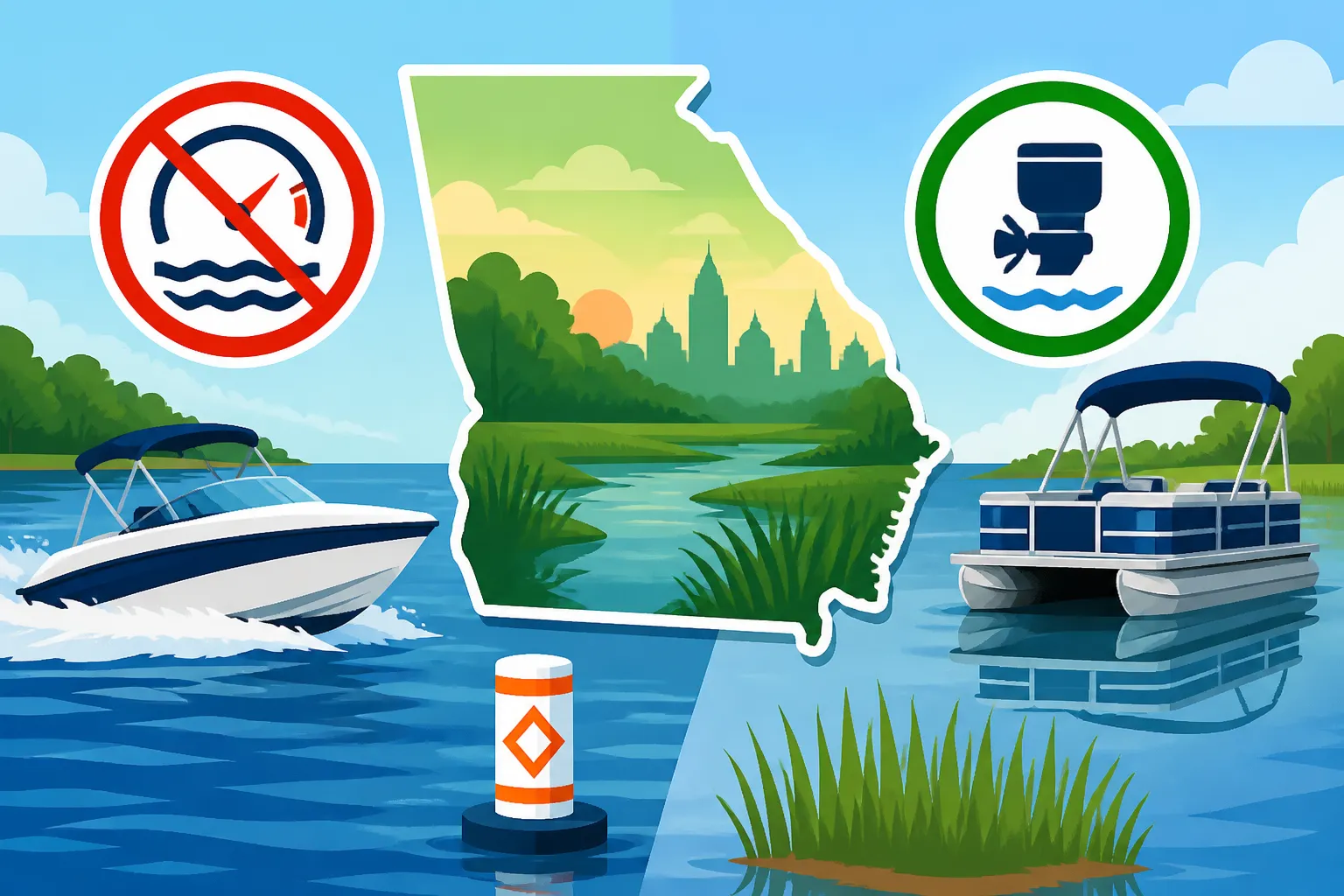
| No-wake buoy or sign | A marked restricted area | Slow before entering and remain slow until clear |
| Marina or cove restriction | A local rule or safety instruction for a confined area | Check signs, maps, and the lake manager’s current guidance |
The terms can be used differently in everyday conversation, but do not treat “no wake” as permission to travel at a particular speed just because a speed limit is not posted. Follow signs and local instructions, and use a speed that keeps your wake from endangering people or damaging property.
For a closer look at the distinction, see Idle Speed or No Wake: Sorting Out the Terms on a Georgia Lake and Georgia’s Idle Speed Rule Near Docks, Boats and Shorelines.
Why the difference matters
A posted no-wake zone and a general close-proximity idle-speed requirement are not the same thing. A lake may have marked zones around a marina, ramp, or narrow passage, while a separate state rule may require idle speed near specified people, structures, or vessels even where no buoy is present.
That means the absence of a sign does not automatically mean you may travel at cruising speed. Likewise, a posted zone may have boundaries and local details that you need to understand before entering. Treat the general rule and posted restrictions as overlapping protections, not alternatives.
Where Georgia Boaters Need to Slow Down
The first task is recognizing situations where a restricted speed applies. Some zones are marked; others follow from the area you are approaching or the general rule about operating close to people and property.
Posted zones and local restrictions
Look for no-wake signs, buoys, and notices at entrances to marinas, coves, public access areas, and other constrained waters. Signs may be mounted on shore, near docks, or on floating markers. A marked zone can cover more water than the immediate space beside the sign, so do not assume you may accelerate as soon as you pass it.
The responsible lake or facility manager may also publish local navigation rules. On a managed reservoir, that manager could be a federal agency, a state or local authority, or a utility. The rules and restrictions can differ from one waterway to another. If you are unsure who manages the water, Who Manages Which Georgia Lake: Corps, Georgia Power and State Parks can help you understand why it matters.
Close to docks, shorelines, people, and boats
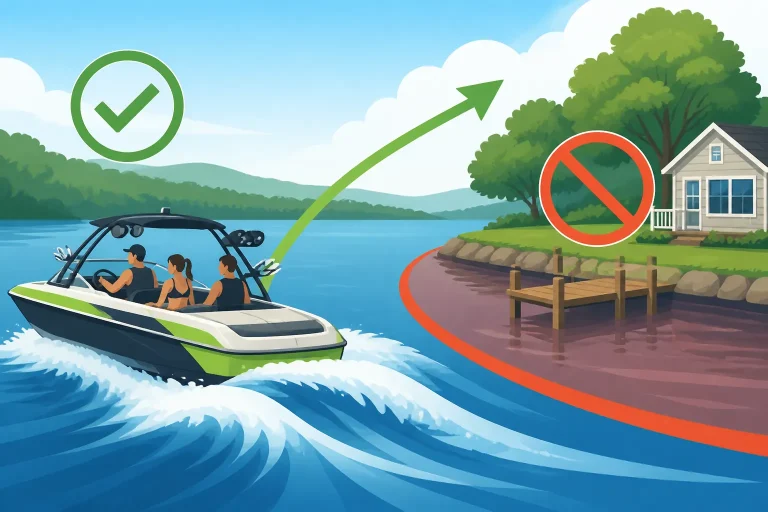
Georgia has a general idle-speed restriction when operating within 100 feet of certain people, structures, or vessels. The rule is commonly relevant near docks, piers, bridges, people in the water, other boats, and shorelines. The exact application can depend on the circumstances and current law, so check the current Georgia requirements rather than relying on a broad summary as a complete legal checklist.
As a practical habit, slow well before you reach a dock, a swimmer, or a boat at anchor. Do not wait until you are directly beside the hazard to pull back the throttle. A boat takes time and distance to slow, and its wake can continue traveling after the boat has passed.
Some activities and boat types may also have additional spacing or operating requirements. Wake boats, personal watercraft, and vessels towing a skier or tuber can raise different questions. The general close-proximity rule is not a substitute for checking activity-specific restrictions. For wake-specific details, see Wake Boat Rules in Georgia: Staying Clear of Docks and Shorelines.
Ramps, marinas, and narrow passages
Launching areas combine several risks: boats backing down ramps, people carrying gear, swimmers, vessels maneuvering at low speed, and limited room to turn. Keep speed low, maintain a lookout, and avoid cutting across the paths of boats that are launching or retrieving.
Marinas and channels can also have crosswinds, blind corners, traffic moving in both directions, and boats backing away from slips. A wake that seems small in open water can bounce off seawalls and docks, rocking moored vessels or knocking people off balance. In a confined area, slow early and leave room to maneuver.
For location-specific guidance, Navigating No-Wake Coves and Marinas on a Georgia Lake and Docks, Ramps and Swim Areas: Where Georgia Wants You at Idle Speed cover common trouble spots.
Do not rely on signs alone
A sign may be missing, hard to see, obscured by glare, or placed where it is difficult to notice from your direction of travel. A marker can also be damaged or temporarily displaced. Keep watching for the area’s layout and activity, not just the next posted instruction.
If you enter unfamiliar water, reduce speed while you work out where the channel runs and what traffic is doing. A slow approach gives you more time to interpret signs and avoid a sudden turn near a dock or another boat. If you cannot tell whether you are inside a restricted zone, choose the safer, slower option until you can confirm.
How to Read and Enter a No-Wake Zone
Good zone awareness starts before the boat reaches the boundary. The operator should know what to look for, slow at the right time, and keep the boat under control through the entire restricted area.
Watch for more than one kind of marker
A restricted area may be identified by a sign, buoy, shoreline notice, marina instruction, or a combination of cues. Read the wording carefully. A marker may identify a no-wake area, a speed limit, a hazard, or a route to follow. Do not assume all buoys use the same wording or that every local sign has identical placement.
Use a chart or lake map when available, but remember that maps may not show every temporary notice or local restriction. Check facility information and current notices from the organization that manages the water. If you are heading to a new lake, allow time to review the local rules before launching.
Reduce speed before the boundary
Do not wait until the bow is at the sign to make a sharp throttle change. Ease off early enough that the boat is already moving slowly as it enters the zone. A gradual reduction is easier on passengers and gives the operator more time to judge traffic.
In a larger boat, a throttle change does not stop the boat immediately. Wind and current may also push the hull forward or sideways. Leave room for that momentum, especially when approaching a marina entrance, a narrow cove, or a row of docks.
Stay slow until you are clearly out
A zone does not end just because you have passed the marker that announced it. Look for a clear exit marker or other reliable indication that the restricted area has ended. If you are uncertain, keep your speed down rather than accelerating prematurely.
When leaving a cove or marina, continue to consider the surrounding traffic and property. Even outside a marked zone, a nearby dock, swimmer, or vessel may mean you still need to operate at idle speed or otherwise reduce your wake. The speed that is reasonable in open water may not be safe in a crowded passage.
Keep a lookout while managing speed
Slowing down does not remove the need to steer and scan. Watch for swimmers, paddlers, boats entering from side channels, lines in the water, and vessels with limited maneuvering room. Ask a passenger to help watch if the operator’s view is obstructed, but do not hand off responsibility for safe operation.
The rules for yielding and passing still matter in restricted areas. A no-wake zone does not automatically give one vessel the right of way over another. Review Right-of-Way on Georgia Waters: Crossing, Overtaking, Channels if you are unsure how to handle crossing or overtaking traffic.
How to Control Wake in Real Conditions
The operator’s speed is important, but it is only one part of wake management. A wake can be larger than expected, particularly when a boat is heavily loaded or moving through a confined area.
Consider hull, load, trim, and direction
Different hulls leave different wake patterns. The same boat can also behave differently with a changed passenger load or equipment placement. Keep people and gear secured, distribute weight appropriately, and avoid abrupt changes in trim that could affect handling.
A boat’s direction can matter as much as the wake itself. Waves can reflect off shorelines and structures, reach docks from an unexpected angle, or cross another boat’s path. Where space permits, choose a course that reduces the impact on people and moored vessels. Do not make a sudden turn that creates a new hazard for traffic around you.
Slow down before the wake becomes a problem
If you see a dock, kayak, swimmer, or anchored boat ahead, reduce speed early. Waiting until you are close may leave too little distance to slow smoothly. The boat’s wake may also reach the hazard after the hull has passed, so do not use the moment you clear an object as a signal to accelerate.
If someone waves or calls for you to slow down, take the request seriously. They may be seeing the effect of your wake at a dock or shoreline that is outside your field of view. Reduce speed, check that your wake has settled, and continue only when it is safe and permitted.
Do not use a speedometer as proof of compliance
A speed reading does not show wake size, steerage, or the effect of your boat on nearby people and property. In a restricted area, follow the idle-speed requirement or posted instruction even if your speedometer suggests your boat is moving slowly. If the water is rough or the boat is hard to control, prioritize safe handling while staying within the applicable rule.
If you need to make a maneuver, do so deliberately. Avoid sudden acceleration to get through a tight spot. If you cannot safely maintain control at the lowest setting, reassess your route and make the smallest adjustment needed to steer. The aim is to remain in control without generating unnecessary wake.
Be considerate even when no restriction applies
A legal speed is not automatically a courteous speed. A large wake can rock a small fishing boat, unsettle a kayak, or send water over a low dock. It can also create a series of waves that reach the shore after the operator has moved on.
When passing paddlers or small craft, provide space and reduce speed early. A kayak may be difficult to see against glare, and its occupants may have little ability to avoid a passing wake. See Sharing the Water: Powerboats and Paddlers on Georgia Lakes for more on safe, considerate passing.
Different Areas, Different Authorities
Georgia’s waters include reservoirs, rivers, coastal waterways, and smaller lakes. The state’s general boating rules are only part of the picture. A local restriction or the rules of the organization managing a particular property may add instructions that boaters need to follow.
Know who manages the water
Some Georgia lakes are managed by the U.S. Army Corps of Engineers, others by Georgia Power, and others by state or local authorities. On coastal waters and rivers, additional navigation conditions may affect the route and safe speed. The manager can provide information about restricted areas, closures, access points, and local notices.
Before a trip, check the official information for the lake or facility you plan to use. Look for restrictions that affect the specific activity, not only general boating rules. A rule for one ramp, cove, or shoreline should not be assumed to apply everywhere, and a rule from a different lake should not be carried over without checking.
Posted restrictions may change by location
A busy public ramp may have a clearly marked slow area, while a different launch site may use signs or instructions posted on shore. A marina can have its own traffic pattern. A cove may have a local no-wake boundary that is not obvious from the open-water approach.
Local restrictions can also address activities that involve towing, wake sports, or close passes. If your plan includes one of these activities, check the relevant rules separately. Towed Water Sports in Georgia: Skiing, Tubing and Observers and Wakeboarding and Wakesurfing Law in Georgia: What Changed address related requirements.
A border lake can involve more than one set of rules
If you are boating on a lake that crosses a state line, do not assume every part of the trip is governed by one state’s rules. The applicable requirements may depend on where you are operating and on any agreements or local regulations for that water. Lake Hartwell, for example, is a border lake where checking the rules for the area you will use is sensible. See Lake Hartwell Border Waters: Georgia or South Carolina Rules?.
Even when the speed restriction appears similar, the details, enforcement, and posted local requirements may differ. Confirm rules with the relevant state and lake manager before launching, especially if you plan to travel across a state boundary.
Confirm information before launch day
A simple pre-launch check can prevent confusion on the water:
- Identify the agency or organization that manages your destination.
- Review current boating notices and local speed or no-wake restrictions.
- Check maps or charts for marinas, narrow passages, and marked zones.
- Ask the marina or ramp staff about local rules if a boundary is unclear.
- Plan to slow early and keep speed low until you know the zone has ended.
This is particularly useful when visiting a lake for the first time or boating during a busy weekend. Conditions and notices can change, so an old map or a friend’s memory may not be enough.
Common Mistakes and What to Do Instead
Most problems around no-wake areas come from entering too fast, misunderstanding the boundary, or focusing on a sign while missing what is happening around the boat.
Mistake: treating no wake as a fixed speed
A particular number on a speedometer does not guarantee that a boat is making no hazardous wake. The boat’s hull, load, trim, and surroundings affect the result.
Do instead: reduce speed early, observe the waves behind and beside the boat, and adjust until the wake is minimal while you retain control.
Mistake: slowing only when a sign is directly ahead
By the time the bow reaches a marker, the boat may still be moving too fast to enter a restricted area safely. Sudden throttle changes can also unsettle passengers and complicate steering.
Do instead: scan ahead for signs, docks, traffic, and shoreline activity. Begin slowing with enough distance to enter the area at the required speed.
Mistake: accelerating as soon as one marker is behind you
The zone may extend beyond the marker, and another restriction may apply close to a dock or person in the water. A wake continues to travel after the boat moves away.
Do instead: look for a clear boundary and check nearby activity before accelerating. If the area’s end is uncertain, remain slow.
Mistake: assuming an unmarked area has no speed restriction
The general idle-speed requirement near certain people, vessels, or structures can apply even when there is no visible no-wake buoy. A missing sign is not a reliable reason to maintain cruising speed close to a hazard.
Do instead: use the general close-proximity rule as a baseline and slow whenever the situation calls for it. Read Georgia Powerboat Operation Rules: Speed, Lookout and Care for a broader overview of safe operation.
Mistake: focusing on the hull and ignoring the wake
The boat may have passed a dock, but its wake can still arrive seconds later. That delay makes it easy to underestimate the effect of a pass.
Do instead: consider where the wake will travel, not just where the boat is. Give docks, swimmers, and smaller craft enough distance and time for the water to settle.
Mistake: confusing courteous behavior with the legal minimum
A boat may be outside a posted zone and still be too close or too fast for the conditions. Courtesy matters, but it does not replace legal requirements.
Do instead: follow both the rules and prudent seamanship. When in doubt near people, docks, or small boats, slow down and leave more room.
Frequently Asked Questions
Does Georgia require idle speed near docks and shorelines?
Georgia has a general idle-speed restriction within 100 feet of certain people, vessels, and structures, commonly including docks and shorelines. Confirm current law and any local restrictions before boating.
Is no-wake the same as idle speed?
The terms are related but not identical in every context. Idle speed describes the slowest speed at which the boat can maintain steerage; no-wake focuses on limiting the wake. Follow the posted instruction and the applicable idle-speed rule.
Can I go faster once I pass a no-wake buoy?
Not necessarily. Check that you have clearly left the marked zone and are not still near a dock, swimmer, vessel, or other restricted area. Keep your wake in mind as you accelerate.
What should I do if I cannot tell where a zone ends?
Stay slow until you can confirm the boundary. Check signs, maps, or the lake manager’s information, and ask marina or ramp staff when available.
Disclaimer
This article is for general informational purposes only and does not constitute professional advice. Laws, prices and regulations vary by location and change over time. Consult a qualified professional for guidance on your specific situation.