Navigating No-Wake Coves and Marinas on a Georgia Lake
A narrow cove or marina entrance can turn a relaxed Georgia lake outing into a close-quarters navigation problem. The challenge is not just slowing down: you need to understand what “no wake” means, spot where it applies, and leave enough room for docks, swimmers and other boats. These practical steps help you approach, pass through and leave busy areas with less risk and friction.
What No-Wake and Idle Speed Mean on Georgia Lakes
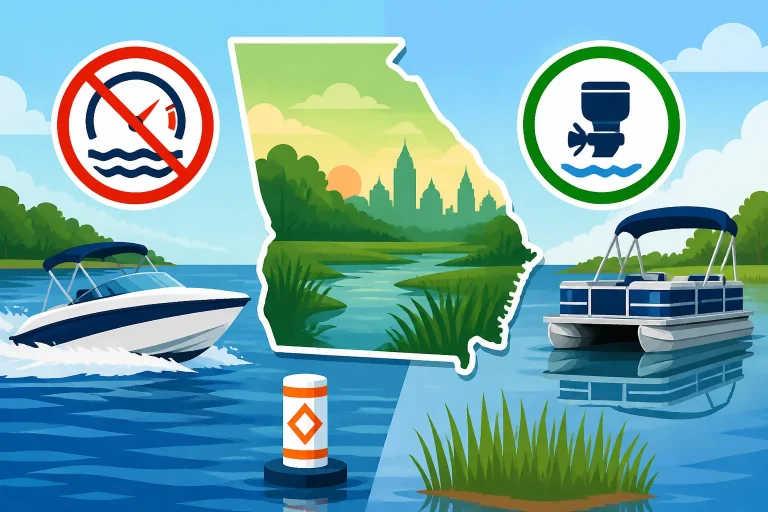
“No wake” is a direction to operate without creating a wake that could endanger people or damage property. “Idle speed” describes a very slow operating speed, generally the slowest speed that still lets you maintain control and steer. On the water, the terms are often used together, but they are not a promise that your boat produces no waves at all.
A boat’s wake depends on more than its speed. Hull shape, load, trim, water depth and how the boat moves through the water all matter. A boat traveling slowly can still make a noticeable wake, particularly when it is heavily loaded or passing close to a dock. A boat that is moving faster may create a larger or longer-lasting wake, even after it has passed.
The practical test is not simply whether the throttle is barely open. Ask whether your boat is creating waves that could rock a nearby vessel, wash against a dock or disturb people in the water. If it is, ease off further, change your approach or wait for a safe opening.
Georgia boating rules include idle-speed requirements near certain close-quarters hazards, such as docks, piers, bridges, people in the water and other vessels. Posted no-wake zones may add restrictions in a cove, marina, channel or other specific location. The exact boundary and applicable rule can depend on the location and signs in place, so do not assume every lake or cove is marked the same way. For a broader explanation of how the terms are used, see Idle Speed or No Wake: Sorting Out the Terms on a Georgia Lake.
A few important distinctions make the rule easier to apply:
- Idle speed is not necessarily one fixed speed for every boat. A speed that keeps one vessel controllable may be too fast for another boat or too fast for the conditions.
- A posted no-wake zone calls for more than a quick reduction in speed. Operate so your boat does not send a damaging or disruptive wake toward nearby boats, docks or people.
- A visible wake is not the only concern. A passing vessel can make an anchored boat roll or push water against a shoreline even when the waves do not look large from the helm.
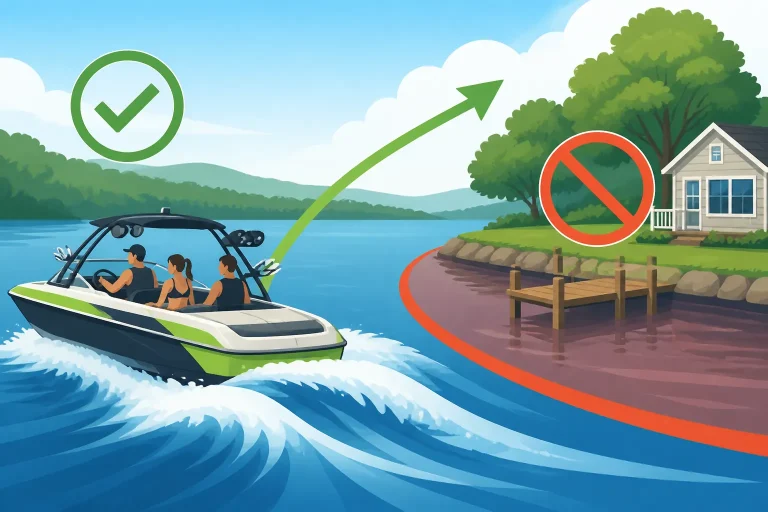
- The marked boundary matters. Slow down before entering the zone rather than waiting until the bow reaches a sign or a cluster of docks.
An important part of staying safe is recognizing where rules overlap. A marina entrance may be inside a posted no-wake area and also place you close to docks and vessels. A narrow cove may have no sign at its mouth but still have docks, swimmers or anchored boats that call for an idle-speed approach. When in doubt, reduce speed early and proceed cautiously.
The broader explanation in Georgia’s Idle Speed Rule Near Docks, Boats and Shorelines can help you understand where the state’s close-quarters rule applies. Treat that as a starting point, not a substitute for reading local signs or checking the rules that govern the lake you are visiting. Some water areas have management rules or temporary restrictions that are specific to the site.
How to Find and Enter a No-Wake Cove
The safest time to prepare for a no-wake cove is before you reach it. A cove entrance may be partly hidden behind a point of land, crowded with boats or approached from open water where other traffic is moving at very different speeds. Looking ahead gives you time to reduce speed without making a sudden turn or surprising the boat behind you.
Watch for signs, markers and changing conditions
Scan the shoreline and water ahead for posted signs, buoys or other markers indicating a no-wake zone or a restricted area. Signs can be easier to miss when you are approaching from an unfamiliar direction, in bright glare or among shoreline structures. A marker may also be set well before the cove itself, giving boaters room to slow down.
Do not rely on memory alone. A familiar lake can have different rules at different coves, marinas or access areas. Conditions and restrictions can also change. If signs are unclear, hard to see or appear inconsistent, slow down and avoid assuming that open-water speed is appropriate.
Look beyond the entrance markers, too. Check for:
- Docks extending into the cove
- Anchored or drifting boats
- Swimmers, paddlecraft and tow-sports activity
- Narrow turns that limit visibility
- Boat traffic entering or leaving a marina
- Floating debris or shallow water near the edge
If your view is blocked, treat the unseen area as occupied. Reduce speed before turning in, stay in a position where you can see as much of the route as possible, and be ready to stop or yield.
Slow down before turning in
A common mistake is to carry open-water speed too close to the cove, then make a sharp turn and pull the throttle back at the entrance. That leaves little time to respond if another boat is coming out, and the wake created during the approach may reach docks or boats even after you slow down.
Instead, reduce speed early and steadily. Let other operators see that you are slowing, keep a lookout astern as well as ahead, and leave room for a boat that may be leaving the cove. Avoid abrupt changes in direction or speed unless an immediate hazard requires them.
On a busy lake, the boat behind you may not expect you to slow down. That does not make it safer to enter too fast. Signal your intention when appropriate, keep your course predictable and avoid slowing in a way that creates a collision risk. If traffic is too close for a safe turn, wait in open water until you have room to make the approach.
Keep your route and speed predictable
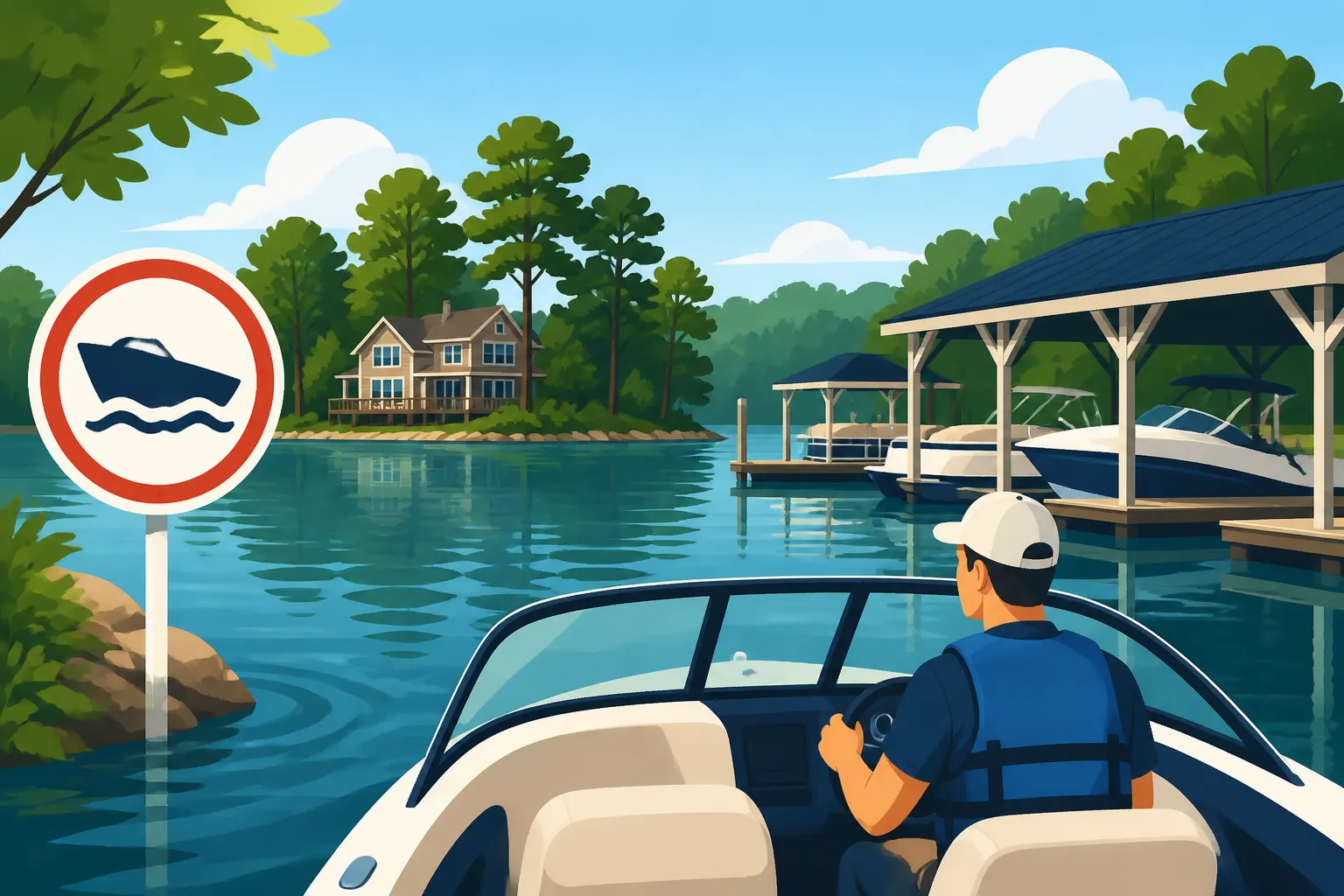
Once inside, travel slowly enough to retain control and minimize your wake. Keep a safe distance from docks and other boats rather than squeezing through a gap because it looks just wide enough. Be especially careful around people swimming near a dock or floating beside a vessel; they may be hard to see from the helm.
Stay alert for boats that are backing away from a dock, turning in a tight space or preparing to leave. If you can safely give them room, do so. In a tight passage, slowing down and allowing the other boat to move first can be safer than trying to pass at the same time.
The advice in Navigating No-Wake Coves and Marinas on a Georgia Lake concerns a situation that can look simple from a distance but become crowded quickly: several boats may be turning, docking or waiting in a small area. A calm, steady approach gives other operators more time to understand what you intend to do.
Approaching and Moving Through a Marina
A marina is a place to slow down, look around and make deliberate decisions. It may contain narrow channels, docks on both sides, boats reversing out of slips, fuel docks, service areas and people walking or working near the water. Even a marina that appears quiet can have movement you cannot see from the entrance.
Before you enter
Check the marina’s entrance for signs, posted speed restrictions and directions for guest slips or fuel docks. If you have a chart or marina map, review it before reaching the entrance rather than trying to study it while maneuvering. When available, ask the marina for its approach instructions, docking location and any local restrictions before departure.
Assign one person to keep a lookout while another handles lines or fenders. If you are operating alone, prepare lines and fenders before entering and avoid creating distractions at the helm. Make sure passengers understand where to sit and when to stay clear of the bow, stern and dockside edges.
A slow approach should still leave you enough control to steer. Too much speed can cause a collision or produce a wake; too little speed, or a poorly timed gear change, can leave you unable to maneuver in wind or current. Make small adjustments and allow time for the boat to respond.
Pass with room and watch for people
Marina fairways are shared spaces. Keep a lookout for pedestrians on docks, people boarding boats, lines in the water and vessels moving out of slips. Avoid cutting close to sterns or crossing behind a boat that may be reversing. If another vessel is turning or docking, give it space to complete the maneuver rather than trying to pass through the opening.
If you need to stop or wait, do so where you will not block the entrance or the route to a dock. Do not tie up to a private dock or occupy a slip without permission. If you are unsure where to go, call or contact the marina before you arrive rather than making a last-minute turn in a confined area.
Fuel docks deserve extra care. Approach as directed, keep the boat under control and follow the facility’s instructions about where to wait and when to come alongside. A small wake can move a boat against a dock or make handling lines harder for someone already tied up.
Docking is part of no-wake navigation
A low-speed approach is easier to manage than a fast approach that depends on a last-second correction. Before coming alongside, consider wind, current, boat size and the space available. Have lines and fenders ready, and make sure the person handling them can do so without leaning dangerously over the side.
Do not use another boat or a dock as a brake. If the approach is not working, back away when it is safe, reassess and try again. A second approach is usually preferable to a collision, a damaged dock or an injury.
For more information about the gear and inspections that matter during close-quarters boating, see Georgia DNR Safety Gear Inspection: What Wardens Look For and Life Jackets and Safety Gear Georgia Boaters Must Carry. A properly fitted life jacket should be accessible and used as required; having it buried under bags is not a practical safety plan.
Passing Boats, Docks and Swimmers in Tight Water
No-wake areas require patience because boats may be moving slowly in several directions at once. The safe choice is not always to take the shortest route. Give other vessels enough room to maneuver, keep your lookout active and avoid passing so close that your wake or propeller wash affects them.
Make your intentions easy to read
In a cove or marina, sudden turns and speed changes can be difficult for other operators to interpret. Travel in a steady, visible direction where possible. Before crossing another boat’s path, make sure the operator can see you and that you have enough room to pass without forcing an abrupt change in course.
If the situation is uncertain, slow down and let the other vessel’s movement become clear. Do not assume that an operator sees you just because you can see them. Boats have blind spots, and people at the helm may be focused on docking lines, passengers or a nearby obstruction.
Right-of-way rules still apply in close quarters, but a formal rule does not eliminate the need for caution. Avoid relying on another operator to make the perfect maneuver. Right-of-Way on Georgia Waters: Crossing, Overtaking, Channels explains how to think about crossing, overtaking and channel situations on Georgia waters.
Give swimmers and paddlers extra space
People in the water can be difficult to see, especially when they are close to a dock, beside a boat or partly hidden by glare. Keep a careful lookout and do not assume that a swimmer will hear your engine or know which way you plan to go. Reduce speed early and give them room.
Paddlecraft can also be hard to spot in a crowded cove. A kayak or paddleboard may be low in the water and hidden behind a pontoon or dock. Look for movement, paddles and people, not just the outline of a hull. Sharing the Water: Powerboats and Paddlers on Georgia Lakes offers more detail on making room for smaller craft.
When approaching an anchored boat, remember that the people aboard may be swimming or handling gear out of view. Pass at a safe distance, minimize wake and avoid cutting between the boat and its anchor line if you can reasonably use another route.
Do not use another boat’s wake as a reason to speed up
A crowded cove may have boats moving at different speeds. If another vessel creates a wake, do not respond by accelerating through the area or making an abrupt turn toward the shore. Reduce speed, keep a steady course and give nearby boats time to settle.
Wake can travel toward a dock or anchored boat after the passing vessel has moved on. If you see someone’s boat rocking, pause or continue at a reduced speed until the water calms. Your own boat may also create wake when turning, accelerating or carrying a heavy load. Check the result of your maneuver, not just the throttle setting.
| Situation | Safer response | Common mistake |
|---|---|---|
| Approaching a marked cove | Slow down before reaching the marker and check for traffic | Waiting until the entrance to make a sharp speed change |
| Entering a marina | Follow posted directions and maintain a controlled, low-wake approach | Assuming the entrance is clear because no boat is visible at first |
| Passing a dock | Leave room and minimize wake | Cutting close to the dock to save time |
| Meeting a paddlecraft | Keep watching it and give it space | Looking only for larger motorboats |
| Waiting to dock | Keep clear of the channel and prepare lines in advance | Stopping where other boats must pass close by |
| Unclear local restriction | Slow down and check signs or ask the site operator | Treating the absence of a visible sign as permission to travel fast |
Common Mistakes and a Better Plan for Your Next Trip
The most frequent no-wake problems are not complicated; they happen when a boater notices a hazard late, assumes a speed is safe because it feels slow, or focuses on docking and stops scanning the surrounding water.
Mistakes to avoid
- Braking at the last moment. A boat does not stop like a car. Reducing speed early gives you more time to react and limits the wake created during your approach.
- Watching only the bow. Boats may be approaching from behind or turning across your route. Check around the boat regularly, including astern.
- Assuming a familiar cove has the same rules everywhere. Posted restrictions can differ by location. Read the signs where you are, even if you have visited the lake before.
- Treating idle speed as a universal number. Boat handling differs by vessel and conditions. Use a speed that lets you control the boat while minimizing wake.
- Following too closely. If the boat ahead slows or turns, leave room to respond. A short following distance can force you into a sudden maneuver.
- Letting passengers distract the operator. Ask passengers to wait until the boat is stopped or securely tied up before moving around, handling loose gear or leaning over the side.
- Trying to force a docking attempt. If your approach is poor, make room and try again instead of carrying too much speed into a tight space.
For a refresher on the responsibilities that apply beyond a single cove or marina, Georgia Powerboat Operation Rules: Speed, Lookout and Care is useful context. Boater education providers, including BoaterExam, may offer study materials, but use an approved course when you need to meet Georgia’s education requirements. A course is not a substitute for local signs, careful lookout or sound judgment on the water.
A basic piece of equipment can also help you manage close quarters. Keep lines and fenders in good condition and where you can reach them before you enter the marina. A marine retailer such as West Marine can be one place to compare boating supplies, but choose gear suited to your boat and the conditions where you operate.
A simple approach routine
Before entering a cove or marina, use this sequence:
- Scan ahead and behind. Look for markers, docks, swimmers, anchored boats and traffic approaching from astern.
- Reduce speed early. Make the change while you still have room and before a turn or narrow passage.
- Confirm the route. Follow posted signs and marina directions. If you cannot see far enough ahead, proceed cautiously or wait for a safe opening.
- Set up the boat. Prepare lines and fenders, secure loose gear and tell passengers what to expect.
- Proceed steadily. Keep a lookout, leave room for other boats and avoid sudden turns or acceleration.
- Check the effect of your wake. If nearby boats or docks are being disturbed, slow further or change your route when safe.
This routine does not replace the rules that apply to a specific lake, but it helps turn them into workable decisions. No-wake navigation is a mix of legal compliance and courtesy: the aim is to stay in control while avoiding unnecessary risk to people, boats and property.
Frequently Asked Questions
Does no-wake mean a boat must be completely still?
No. It means operating without creating a wake that endangers people or damages or disrupts property. A boat may need to move slowly to remain steerable, but its operator should minimize the wake it creates.
Is idle speed the same for every boat?
No. Boats differ in handling, hull design and response to conditions. Use the slowest speed that lets you maintain control, and slow further if your boat is still creating a disruptive wake.
Can I assume an unmarked cove is not a no-wake area?
No. Some restrictions may be posted, and close-quarters speed rules can apply near docks, people in the water and other vessels. Watch for signs and hazards, and check local rules rather than relying on the absence of a marker.
What should I do if another boat is creating a large wake in a cove?
Stay in control, reduce speed if needed and give the other boat room. Avoid a sudden turn or acceleration in response. Once the wake reaches your area, allow nearby boats time to settle before proceeding through a tight space.
Disclaimer
This article is for general informational purposes only and does not constitute professional advice. Laws, prices and regulations vary by location and change over time. Consult a qualified professional for guidance on your specific situation.